Do Gua Sha Work? How to Fit Facial Massage Into Your Daily Routine
By:Author:Nord Yoga Editorial
Updated on:September 30, 2026

- Does Gua Sha Actually Work?
- Why This Beats the Harder Alternative
- The Quantity Question: How Much Gua Sha Do You Need?
- The Practical Question: Fitting Gua Sha Into a Real Day
- Comparison: Gua Sha Versus Other Facial Tools
- The Forbidden Promise, Answered Honestly
- Levers That Change the Result
- How Long Until You See Results?
- Your First Four Weeks With Gua Sha
- What Stalls Progress
- Why Nord Yoga Works for This
- Final Thoughts
Gua sha works as a massage tool, not a magic wand: it moves fluid and relaxes tight facial muscle, but it cannot reshape bone or melt fat off your jaw.
The mechanism is simple friction and pressure - the flat edge glides over skin, encourages blood flow to the area, and gives tense muscles something to release against.
This guide covers what the tool actually does, how much practice matters more than pressure, and what a realistic four-week routine looks like.
Does Gua Sha Actually Work?
Strip away the marketing and gua sha is a smooth-edged tool you drag across the face with light to firm pressure.
The friction warms the skin, the pressure pushes against fluid that has pooled overnight, and the repeated strokes give facial muscle a short massage - that's the whole mechanism.
Here is the honest arithmetic: a two-minute session covering forehead, cheeks and jaw touches each area for roughly 20-30 seconds.
That's enough time to move surface fluid and warm the muscle underneath, which is why skin often looks less puffy right after a session.
What it cannot do is change the amount of fat under your chin or the shape of your jawbone - no tool held against skin does that, and any claim otherwise doesn't hold up to how bodies actually work.
Why This Beats the Harder Alternative
Compare gua sha to something like a facial massage device that needs charging, an appointment, or a technique so fiddly you give up after a week.
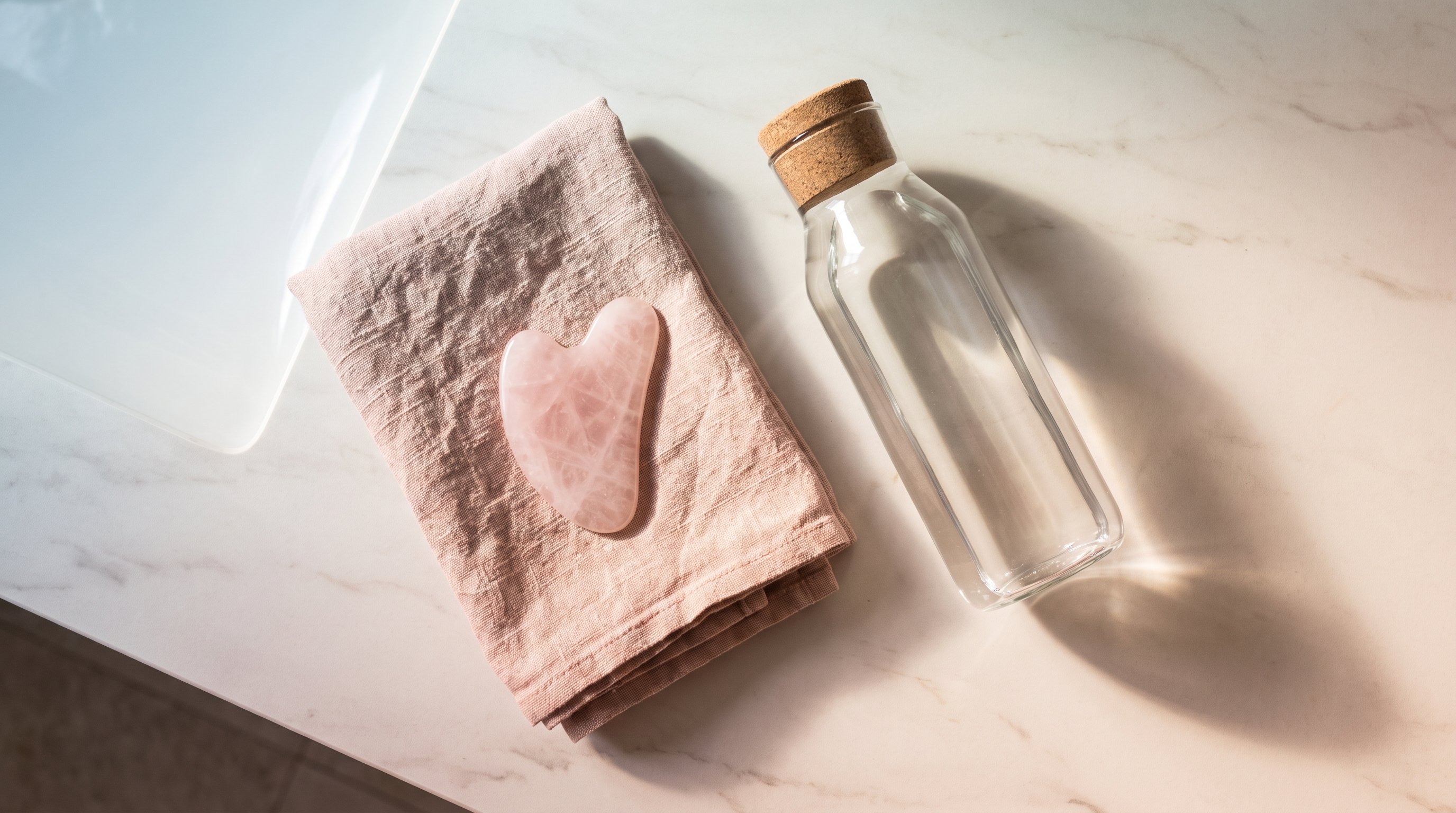
A stone or metal tool needs nothing but your hand and two minutes, which is exactly why it survives on a bathroom shelf longer than most beauty gadgets do.
The adherence math is straightforward: a two-minute habit done most days of the month adds up to far more total facial massage than a twenty-minute routine done twice.
Sessions completed beats intensity per session, every time, because consistency compounds and one-off effort doesn't.
The Quantity Question: How Much Gua Sha Do You Need?
There's no single correct number of strokes, but a workable range exists.
Most routines use somewhere between 5 and 10 passes per area, once a day, with light to medium pressure - enough to feel the drag, not enough to redden the skin for long.
Find Your Own Number
Start low and adjust based on how your skin looks the next morning - if it's still pink or feels tender, cut the strokes back rather than pushing through.
| Area | Strokes | Pressure |
|---|---|---|
Neck | 5-8 passes | Light |
Jawline | 5-8 passes | Medium |
Cheeks | 8-10 passes | Light |
Forehead | 5-8 passes | Light |
Use this as a starting point today, then adjust the pressure column up or down once you know how your skin responds.
The Practical Question: Fitting Gua Sha Into a Real Day
The tool itself is easy - remembering to pick it up every day is the actual challenge.
Most people who stop within a month don't stop because gua sha doesn't do anything, they stop because it never got attached to an existing habit like brushing teeth or applying moisturiser.
This is where a structured plan helps more than a tool on its own - Nord Yoga pairs face yoga sessions with guided video tutorials so the gua sha step sits inside a routine you're already following, rather than being one more thing to remember.
Having the massage technique demonstrated on screen, with a tailored plan around it, removes the guesswork that makes people quit early.
Comparison: Gua Sha Versus Other Facial Tools
Gua sha is one option among several tools that claim to help skin look brighter and less puffy.
Here's how the common choices stack up on cost, effort and what they actually do.
| Option | Cost | Effort | What It Does |
|---|---|---|---|
Gua Sha Stone | Low, one-time | 2 minutes daily | Moves fluid, warms muscle |
Jade Roller | Low, one-time | 1-2 minutes daily | Cools skin, light glide |
Face Yoga Exercises | Free or app-based | 5 minutes daily | Works muscle tone |
Electric Massage Device | Higher, needs charging | 5-10 minutes | Vibration plus pressure |
Manual Hand Massage | Free | 2-5 minutes | Fluid movement, no tool |
The Forbidden Promise, Answered Honestly
No, gua sha does not sculpt a jawline overnight, and no tool can target fat loss in one spot on the body or face.
Fat comes off where genetics decide, not where you scrape a stone, and any claim of overnight facial reshaping doesn't match how skin, muscle or bone actually respond.
The real answer is less exciting but more honest: gua sha can reduce the look of puffiness in the short term and give facial muscle a light workout over time, alongside consistent skincare and sleep.
That's a modest, believable outcome - not a transformation, just a small daily habit doing a small daily job.
Levers That Change the Result
Three factors decide whether gua sha feels worth the two minutes or gets abandoned in a drawer.
What Actually Moves the Needle
- Consistency over pressure - a light daily session beats one hard weekly scrape every time.
- Pairing it with a full routine - gua sha alongside face yoga and a skincare routine tailored to your skin type does more than the tool alone.
- Sleep and hydration - puffiness has causes gua sha can't touch, and enough water plus rest changes how skin looks before any tool does.
How Long Until You See Results?
The de-puffing effect from a single session can be visible right after, which is exactly why gua sha feels satisfying from day one.
The slower changes - skin that looks a little less tired, a jaw and neck that feel less tense - take longer and build gradually rather than on a fixed schedule.
Most people give up in the second or third week, right when the immediate glow has become familiar and the deeper changes haven't shown up yet.
Staying past that point is less about the tool and more about keeping the habit going without expecting a dramatic before-and-after.
Your First Four Weeks With Gua Sha
Order matters more here than exact numbers - build the habit first, refine the technique second.
| Week | Focus | Goal |
|---|---|---|
Week 1 | Learn basic strokes | Daily 2-minute habit |
Week 2 | Add neck and jaw | Consistent pressure |
Week 3 | Pair with skincare | Same time each day |
Week 4 | Add face yoga moves | Full 5-minute routine |

By week four the tool itself has stopped being the point - the daily habit around it is.
What Stalls Progress
Pressing Too Hard
Heavy pressure irritates skin and leaves redness that lasts hours - ease off and let more passes do the work instead of more force.
Skipping Days at Random
An inconsistent schedule means you're always starting from zero - attach the session to something you already do daily, like washing your face.
Using It Dry
Gua sha without oil or serum drags on skin and can cause micro-irritation - always glide over a lubricated surface.
Expecting Bone-Deep Change
Gua sha works on skin and muscle, not skeletal structure - keep expectations at the level of puffiness and tone, not reshaping.
Ignoring the Rest of the Routine
A tool used in isolation, without sleep, water or a skincare routine to match, has less to work with - treat it as one piece, not the whole plan.
Why Nord Yoga Works for This
Gua sha on its own is a good habit; gua sha inside a structured plan is a better one.
Nord Yoga builds face yoga plans tailored to your specific skin concerns, pairs them with video tutorials that show the massage technique step by step, and adds a meal plan built around food that supports skin, so the daily two minutes with a gua sha tool fits into something bigger rather than standing alone.
Final Thoughts
Gua sha does something real - it moves fluid, warms muscle, and gives you two minutes of calm - but it was never going to reshape a jaw, and no honest guide will tell you otherwise.
Keep the habit small, pair it with a routine like the ones inside Nord Yoga, and judge it by how consistent you stay, not by how dramatic the mirror looks after one session.
FAQ
Most gua sha tools cost very little and last indefinitely, so the real cost is the two minutes a day, not the price tag.
That's largely true in the short term - it reduces the look of puffiness by moving fluid, and any longer-term change comes from the muscle massage and habit, not from the fluid movement itself.
Two minutes attached to an existing habit, like applying moisturiser, is the smallest version that still works - Nord Yoga's short guided sessions are built around exactly this kind of time limit.
The initial de-puffing effect becomes familiar and the deeper changes take longer to notice, so motivation dips right when patience matters most.
Share this post